Pages

Friday, May 28, 2010

Learning while I Create the President’s Quilt


When the White House was nearly finished in late 1800s, President John Adams of Massachusetts was its first occupant. John & Abigail Adams did not own slaves !! The second occupant, Thomas Jefferson of Virginia, started a tradition that continued with other slave-holding presidents — they brought their personal slaves to help staff the White House.

In 1801, President Jefferson took about a dozen slaves from Monticello with him as he set up occupancy in the White House. Many lived in quarters on the White House’s first floor, while others slept on the second floor in the first family’s quarters. While largely overlooked, the role of slaves in building the president’s home has drawn some attention in recent years.

Do check this out!! they cherished liberty


www.avengingtheancestors.com


Avenging The Ancestors Coalition (ATAC) is a broad-based organization of African American historians, attorneys, elected officials, religious leaders, media personalities, community activists, and registered voters. ATAC was founded in 2002 to compel the National Park Service (NPS) and Independence National Historical Park (INHP) to finally agree to the creation of a prominent Slavery Commemoration as a key component of the President's House project. The purpose of this Slavery Commemoration is to honor primarily the nine African descendants enslaved by President George Washington at the President's House, which is also known as America's first "White House" and which was located at the current site of the new Liberty Bell Center in Philadelphia at Sixth and Market Streets. Those nine were among the 316 Black men, women, and children enslaved by Washington at his Mt. Vernon, Virginia plantation.

After years of letter-writing campaigns, petition drives, demonstrations, public forums, press conferences, and negotiations, ATAC was victorious in persuading the NPS and INHP to finally concede to the creation of this absolutely historic Slavery Commemoration, now called the President's House/Slavery Commemoration Project.

The Truth Be Told….


The issue of slavery plagued Washington throughout his years in Philadelphia. By the time that Washington arrived here, he had privately begun to express doubts about that institution, but he also expressed frustration with those who worked openly against slavery. Despite his misgivings about slavery, while living in the President's House, Washington signed into law the Fugitive Slave Act of 1793. This notorious law mandated the return of enslaved persons to their owners and made it a crime to aid in the escape of the enslaved.

Washington also took pains to ensure that those he enslaved could not secure their freedom under the terms of Pennsylvania's Gradual Abolition Law of 1780. Washington was unsure if the law applied to him, but if it did, it would have allowed enslaved Africans he brought into the state to secure their freedom after six months residence in Pennsylvania. In order to keep this from happening, Washington secretly made arrangements for the slaves he brought to Philadelphia to be rotated out of the state before the six-month deadline arrived. Even a brief trip across state lines would restart the clock on the waiting period.
Washington eventually did decide to free his slaves. However, under the terms of his will, this belated freedom only came after both he and his wife died, and then only for some. Martha's dower slaves, who legally belonged to her family's estate, were not freed.

Philadelphia in Philadelphia County, Pennsylvania — The American Northeast (Mid-Atlantic)

President’s House Project (PA)

In the 1790s, The nation’s first capital was located at 6th & Market Streets in Center City, Philadelphia: and the home of George and Martha Washington -- theirs was the biggest house in town. Nine enslaved Africans were among the approximately 24 individuals who served George Washington and his family and staff at the President's House. Today we are learning that the foundation of the first presidential oval office, which originated at this house, survives. Archeologists continue to discover evidence from the new nation — evidence thought to be long lost.

Wednesday, May 26, 2010

WHY BUY FABRIC . . .

When I don't even like it..........


now I know.....


more on this fantastic post tommorrow..... :)

Monday, May 24, 2010

PIECING MY FAMILY STORY


When is a HOUSE A HOUSE.... and a home a home?


When is a shack a shanty....does the coin-value denote the worth of a slave quarter next to the the BIG HOUSE????


Is this my 40 ACRES AND MY MULE??? ++ 200 YEARS LATER ?? !!


In this later half-century of my life (with grandchildren of my own, and my mother turning 84 yrs this summer) I have been engrossed with the intertwining of our family roots. Lucinda - really no-name -- but assigned the name of the field master "SMITH" by Captain James A. Anderson, the Irish slavemaster who fathered at least 7 children by Lucinda... She bore a total of 14 children per 1900 census wherein her approx date of birth was listed as 1848.

It is in this vein.... that I am engrossed with the reading of American History. Highschool couldn't mean a thing, and a college textbook was a memorized "B". There has always been the living reality of our "passing white" Big Mama, as well as Ada Lois Sipuel Fisher whose 1948 Supreme Court Case (..vs Univ Of Oklahoma Law School).

But whatever reasons, a light cloud was always overcast, and questions were not asked... I learned from Aunt Lois in class and in her speaking engagements. But in the last few years.... I am aggressively piecing together.........MY FAMILY STORY!

AAAAHAAAA ah-haaaa.....PIECING TOGETHER...... MY LIFE STORY WILL BE BROUGHT TO LIFE IN THE TOUCHABLE, READABLE QUILT THAT CAN BE PASSED TO MY GRANDCHILDREN!

And this is what I envision in artistic expressions of women like Heather Williams, Kyra Hicks, Dr. Mazloomi, Maya Angelo and others before me who create, research and highlight the style of African American quilts and the symbolism there within the quilting. I find myself continually...... not in the Euro-American tightly structured star blocks and geese and 9-patches.... but I do love to make these patterns.... BUT

But where I truly find my delight and self-expression coming into play is with a topic... And it's a rather dark --- my family thinks of me as radical, almost negative with the MLK and Malcom X, H-Rap Brown and Angela Y. Davis mentality of the 60-70's. But I must express my past. It's where I find my fulfillment.... in putting American History ---- African-Black-folk history into quilt images!!!

yea... am I a happy campter or what! Praise the Lord!

Stirred by the topic of the President's House

So, it's fair to ask.... "What's driving my passion now...????"


I met Michelle Flamer at the Wilberforce Ohio quilt exhibit in April-2010 and we exchanged e-mail info after she mentioned that she was curating a show highlighting the time period and the subject of "slaves in the President's House in PA."

There is a quilt on the floor of my sewing room......up know I'm ready to stay up all night.....

I've sat and simmered, reading and visualizing the lives of George & Martha, Ona, the chef and the fate of Blacks men and women in the early 1600-1700-1800's on American soil.

Check the Link in the heading to find out more....

The President's House in Philadelphia: according the George Washington's correspondence and maps: there were nine enslaved Africans who worked in George Washington's presidential household...brought from the Mt. Vernon plantation owned by Martha & Geroge.

Why are the Slave Quarters important?


“We lived in a kitchen, a room in a log house joined on to the master’s house.”

Sarah Graves, A Missouri Slave


"I believe that it is better to tell the truth than a lie.

I believe it is better to be free than to be a slave.

And I believe it is better to know than to be ignorant." -- H.L. Mencken


Why are the Slave Quarters important?

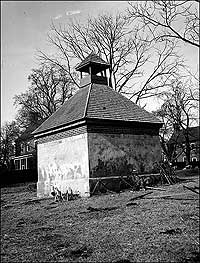
.......George Washington's Presidential House (PA.) The Slave Quarters stands as a commemorative location used exclusively by the enslaved at the beginning of Washington's residence at the President's House. It is in this place we can commemorate the lives, dignity, fears, and struggles of the enslaved of African descent, in the context of power and unpower, of freedom and unfreedom in the making of our nation.
testing one-two-three..... I'm back to the ENGLISH langauge.....

Quiltin My life story

My life is but a weaving – Between my Lord and me, I cannot choose the colors – He weaveth steadily.

Ofttimes He weaveth sorrow – And I, in foolish pride, Forget He sees the upper and I the underside.

Not ‘til the loom is silent – And the shuttles cease to fly - Shall God unroll the canvas - And reveal the reasons why.

The dark threads may be needful – in the skillful weavers hand
As the thread of gold and silver In the pattern He has planned.
(Author unknown)

Wednesday, May 19, 2010

Final Post for today….

I love my blog…. Do you?


I’m praying for my dear quilt friend…. That her cancerous diagnosis will be kind to her….. there is healing in His wings!!! Bless the Lord!

Reflections on Harriet’s Falling Stars!

I was inspired @ this visit to the Pioneer Women’s Museum in Ponca City, Oklahoma. There were powerful images of Mary Bethune as well as Clara Luper. It’s my hearts desire to further honor and commemorate these women in quilted statements and imagery!


Meandering thru my 2006,2007, and 2008 files and folder in My Documents… I’ve travelled and taken a good many pictures that I know I want to translate into quilt art….. The falling stars of Harriet Powers!

Just as Every Quilt tells a story . . . .

Every story should start in a park – especially if it tells its own story.
Reconciliation Park is the long-awaited result of the 2001 Oklahoma Commission to Study the Tulsa Race Riot of 1921. It memorializes the Tulsa Race Riot, called the worst civic disturbance in American history.


The Park also tells the story of African Americans’ role in building Oklahoma and thus begins the long-delayed rendering of the full account of Oklahoma’s history.

When construction is complete, the park will feature two primary art elements, created by Ed Dwight, the first African-American astronaut and prominent Denver artist:
• Hope Plaza – The Park entry’s 16-foot granite structure contains three larger-than-life bronze sculptures representing actual pictures from the 1921 riot:
o Hostility – A white man fully armed for assault
o Humiliation – A black man with his hands raised in surrender
o Hope – The white director of the Red Cross holding a black baby


• The Tower of Reconciliation – At the center of the Park, the 25-foot-tall memorial tower depicts the history of the African American struggle from Africa to America – from the migration of slaves with Native Americans on the Trail of Tears, the slave labor experience in the Territories, the 7th Kansas Regiment of Civil War soldiers that won the Battle of Honey Springs – to statehood, the immigration of free blacks into Oklahoma, and the all-black towns and Greenwood. It honors Buck C. Franklin (prominent black attorney and Dr. Franklin’s father) and other early Tulsa black leaders.

John Hope Franklin Reconciliation Park continues the American tradition of erecting memorials based on tragic events by giving voice to the untold story of the 1921 Tulsa Race Riot and the important role African Americans played in building Oklahoma.

The final report of the 2001 Oklahoma Commission to Study the Tulsa Race Riot of 1921 is available at www.okhistory.org/trrc/freport.htm.

I feel a quilt comin’ on STRONG!

You know my heart, hands and mind….. busy ticking….dreaming of a quilt to depict this important event!

“I want to be out there on the firing line, helping, directing or doing something to try to make this a better world, a better place to live.”
– John Hope Franklin


The story of the John Hope Franklin Center for Reconciliation, Inc. is just beginning. It is a story filled with:
• Drama –Waiting eight years for state funding
• Resolve –Securing $950,000+ funding to complete the Park
• Patience – Overseeing construction of Reconciliation Park and establishing an organizational framework
• Action – Launching five major program initiatives in its first year of operation

Beginning with the 2008 groundbreaking for Reconciliation Park, which was Dr. John Hope Franklin’s last public appearance before his death in March 2009, the Center’s Board of Directors has created an exciting vision –
to transform the bitterness and mistrust caused by years of racial division, even violence, into a hopeful future of reconciliation and cooperation for Tulsa and the nation.

They Told Us: Lymphoma 8-31-2009

They Told Us:  Lymphoma 8-31-2009

Copyright